Long before we bought the boat we had decided on the name. In Angola anytime one of the locals did something questionable they would raise a thumb and say “Ta Fixe” which was half a statement and half a question. It is all good, Right? We loved that Portugese saying so much we decided that our boat would be named that. “It is all good, it is fixed, it is cool” Ta Fixe is more about a way of life than an actual name. It is and was what we wanted to convey in our sailing journey. We took our time to make these decisions and it was many years before we even purchased the first boat.
So where did we start on trying to find the right boat to fit in with our plans moving forward? These are some criteria that we had at the time.
On my sail to Bermuda I was on an Irwin 52 (I sailed in 1984) and it was on this boat that I became acquainted with the “dance floor” set up. There was a large gap from the bottom of the companionway to the first handhold in the main cabin. This was a problem for me. The boat had a handrail that ran down the middle of the cabin top for a hand hold… I had not yet reached 5’1 so the hand rail was completely useless to me. So reaching the bottom of the companion way stairs I had to wait for a favorable wave to run across to the next available hand hold. There were many bruises involved in this. When we started looking for the first Ta Fixe a large open main cabin was not something I would consider.
Having three young children (at the beginning of the search) we had to find a boat large enough to sleep five people and small enough to be handled solo as with only two adults we would likely be rotating the watch standing between the both of us. we needed something that was safe, sturdy and was up to the task.
We wanted a monohull. We had a vacation in Greece where we rented a catamaran for a week and decided that we didn’t like the way it moved. The kids all got seasick and in general we did not enjoy sailing it. As we ended up motoring a bunch it also was not the way we like to travel. We are, by nature, sailors. So we try not to motor much when we can get away with a light breeze. We will motor if we are traveling less than 3 knots.
Next Criteria was that I did not want in-mast furling. On my day skipper class we had a boat with in mast furling and frequently had issues with it. The sails were old and didn’t have much shape so it would bunch up and got stuck once or twice half way in or out. Because of this I have never been a fan of those systems. Luckily we were doing a coastal course so it wasn’t catastrophic.
Thus started the look for the boat. We would scour magazines and websites like Yachtworld.com looking for something that would meet our criteria. We also did some sailing on other people’s boats which gave us some additional insight into what we wanted.
We had started to look closely at the larger Passport Yachts and had several conversations with the owner, at the time, Tom Wagner. At the time the center cockpit and bespoke interior wood work had us sold. The only problem was that we were living overseas still and the price tag for a boat that we would have to wait years to sail, was something we struggled justifying. Tom had made an interior design for us on a boat that had the ability to hold the family. He had made it with two large queens in the fore and aft and an over/under bunk along the port side. It was perfect on paper.
That boat never came to be. We moved from Angola, to Dubai and by the time we made it to Amsterdam all of the boys had gone off to school so now our requirements had decreased to a boat that only slept 2 as we had no expectations that the boys were going to help.
We left the USA in 2009 and returned in 2016, There had been many years from the start. We were smitten with the Passport design as in the level of craftsmanship. The newer boats had the dance floor and the more I tried to explain that this was an issue for me the more I felt unheard. Also I was also not happy with the inmast furling and was told that they were willing to do slab or in boom furling if desired.

This photo came off their website and as you can see that when you reach the bottom of the companionway stairs there is a wide open space as you hit the bottom of the stairs, This was not desirable to me.
The classic series of this boat, the 45′ and 47′ were designed by Bob Perry and are much more suitable for what I need to go offshore sailing.
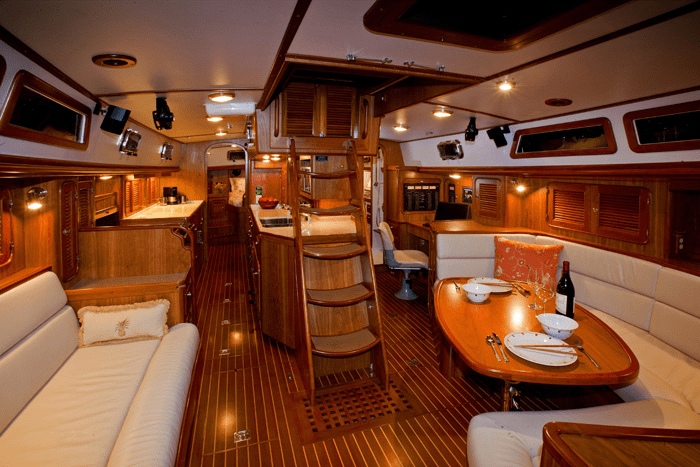
As you can see as there is many places to grab onto as you reach the bottom of the stairs, the table, the settee or even the kitchen counters. There is a bit of open space like the other design but you are never with out something in reach to hold onto. Passport had not yet launched their Voyager Series, which addresses many of these concerns I had.
Due to changes in our residence and jobs we started looking for something smaller. We had moved back to the USA and the North East. The New England coast has lots of nooks and crannies for a smaller boat to access. In my search I learned that there was a point where boat docking and winter storage becomes exponentially higher. At 40′ you are at that threshold. This was an important consideration on the quest to find the right boat.
So in the end the criteria was a used boat, at or less than 40′, with good hand holds, steady underfoot, in our price range and with the ability to go offshore. So after some research we ended up with a Passort 40.
 Sailing on the Lean
Leave a comment